
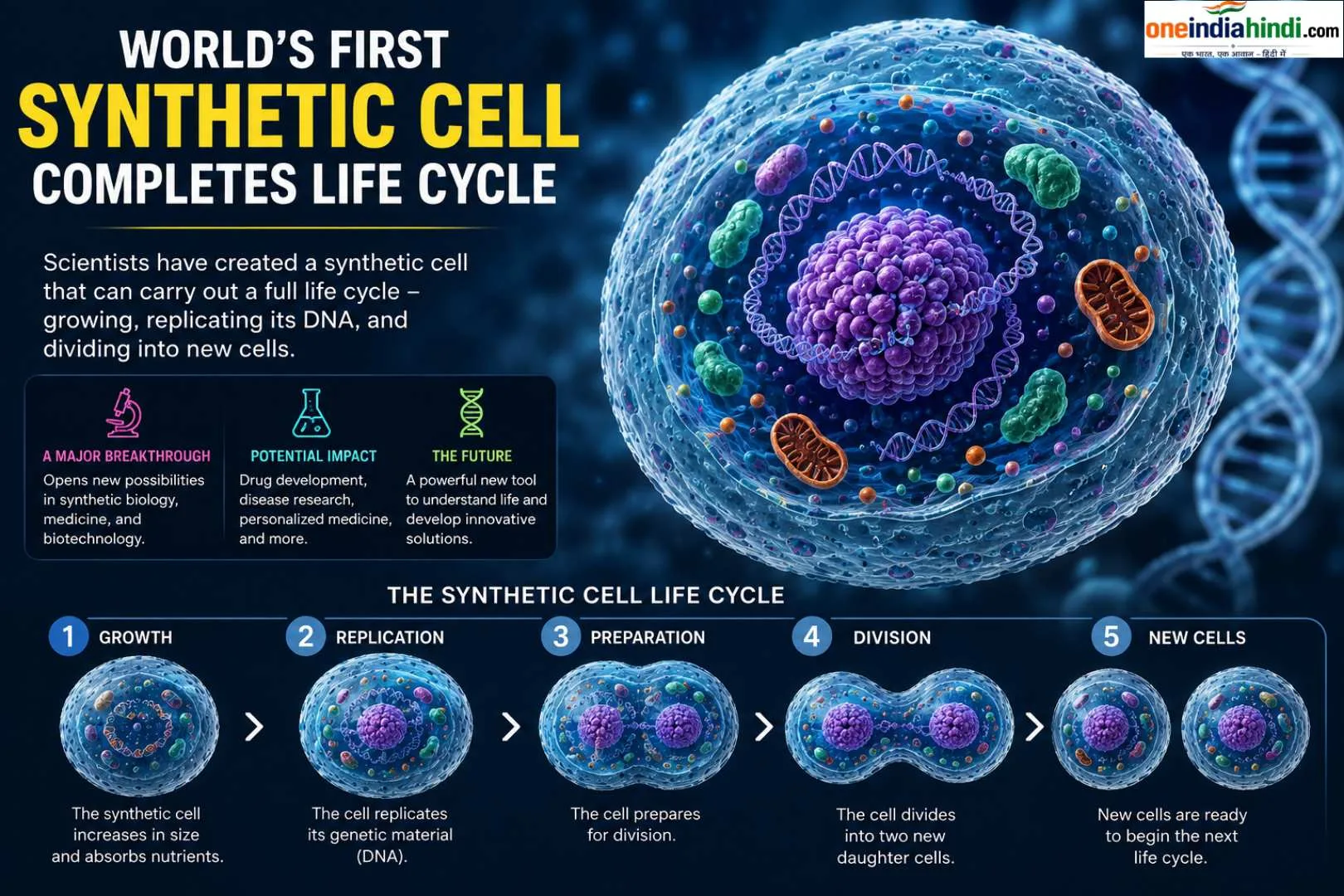
Scientists have achieved an incredible milestone by creating the world’s first synthetic cell that can complete an entire life cycle. This breakthrough opens exciting opportunities in medicine, biotechnology, and biological research.
What Is a Synthetic Cell?
A synthetic cell is an artificial cell built using carefully selected biological materials instead of naturally growing from another living cell. Scientists design these cells to better understand how life works and to explore new ways of treating diseases.
Unlike traditional cells, synthetic cells are created in laboratories where researchers can control their structure and behavior. This allows scientists to safely test new ideas and technologies.
What Does “Synthetic Cell Completes Life Cycle” Mean?
A synthetic cell is an artificial cell created by scientists using carefully selected biological components. Unlike natural cells that develop from existing living cells, synthetic cells are assembled in a laboratory to help researchers understand the basic processes of life.
When scientists say a synthetic cell completes its life cycle, they mean the artificial cell can successfully carry out the essential stages that living cells normally perform. These stages include growing, using energy, copying its genetic material, dividing into new cells, and continuing the cycle under controlled laboratory conditions.
The Main Stages of the Life Cycle
- Cell Growth: The synthetic cell absorbs nutrients and increases in size.
- Energy Production: It uses chemical energy to power internal biological activities.
- Genetic Material Replication: The cell copies its genetic instructions so each new cell receives the information it needs.
- Cell Division: The synthetic cell divides to produce new cells, completing one life cycle.
- Cycle Continuation: The newly formed cells are capable of repeating the same biological process under suitable laboratory conditions.
Completing a full life cycle is a major scientific achievement because it demonstrates that researchers can recreate many of the essential functions of living cells in a laboratory. This gives scientists a powerful way to study how life works and may support future advances in medicine, drug development, synthetic biology, and biotechnology.
Although this breakthrough is significant, these synthetic cells are designed for scientific research. They are not intended to replace natural living organisms, and more research is needed before this technology can be applied in healthcare or other industries.
Why Is This Discovery Important?
The biggest achievement is that researchers successfully created a synthetic cell capable of completing its entire life cycle. This means the artificial cell can perform the key biological processes needed for growth and reproduction under controlled laboratory conditions.
This accomplishment gives researchers a powerful tool to study life at its most basic level and develop future medical innovations.
- ✔ World’s first synthetic cell completing a full life cycle.
- ✔ Major advancement in synthetic biology.
- ✔ Could improve medical research and drug development.
- ✔ Helps scientists better understand how living cells function.
- ✔ May support future personalized medicine.
Detailed Explanation of the Key Highlights
1. World’s First Synthetic Cell Completing a Full Life Cycle
One of the biggest achievements in modern synthetic biology is the creation of a synthetic cell that can complete a full life cycle. This means the artificial cell can perform essential biological processes such as growth and division under laboratory conditions.
2. A Major Breakthrough in Synthetic Biology
This research represents an important advancement in synthetic biology. Scientists can now study biological systems more accurately, helping them develop new medical technologies and improve scientific understanding.
3. Better Drug Development and Medical Research
Synthetic cells may become valuable tools for testing new medicines safely before clinical trials. This could help researchers identify better treatments while reducing development time.
4. Understanding How Living Cells Work
Scientists use synthetic cells to understand how natural cells function. This research could lead to discoveries about diseases, genetics, and new treatment methods.
5. Supporting the Future of Personalized Medicine
In the future, synthetic cell technology may help doctors create treatments tailored to individual patients, making healthcare more precise and effective.
This scientific breakthrough provides researchers with new ways to study biology, improve medicines, develop vaccines, and advance biotechnology. While still in the research stage, it has the potential to transform healthcare in the future.
Potential Applications
1. Better Drug Testing
Researchers may use synthetic cells to safely test new medicines before human clinical trials. This could reduce development time and improve treatment safety.
2. Disease Research
Artificial cells allow scientists to study diseases in controlled environments, helping them discover new therapies for complex medical conditions.
3. Personalized Medicine
Future synthetic cells may help doctors design treatments that match an individual patient’s needs more accurately.
4. Biotechnology
Synthetic biology can improve manufacturing of vaccines, enzymes, and environmentally friendly biological products.
Challenges Ahead
Although this achievement is remarkable, scientists still face many challenges. Synthetic cells are currently designed for research purposes and cannot replace natural living organisms.
Researchers must continue improving safety, stability, and ethical guidelines before this technology can be widely used in healthcare.
What Does This Mean for the Future?
The successful development of a synthetic cell completing its life cycle represents an important step toward understanding life’s basic mechanisms. As research continues, this technology could contribute to breakthroughs in medicine, agriculture, environmental science, and industrial biotechnology.
Scientists developed this synthetic cell to better understand biological systems, not to replace natural life. The technology is mainly intended to support scientific research and future medical innovations.
Frequently Asked Questions (FAQ)
What is a synthetic cell?
A synthetic cell is an artificially designed biological cell created by scientists to study life and improve medical research.
Why is this discovery important?
It demonstrates that scientists can build an artificial cell capable of completing a full life cycle, creating new opportunities in biology and medicine.
Can synthetic cells replace living organisms?
No. They are currently research tools designed to improve scientific understanding and are not replacements for natural life.
How could this help healthcare?
Synthetic cells may improve drug testing, disease research, vaccine development, and personalized medicine in the future.
Conclusion
The world’s first synthetic cell capable of completing a full life cycle is a major achievement in synthetic biology. While the technology is still in its early stages, it has the potential to reshape medical research, biotechnology, and our understanding of life itself.
Source: University of Minnesota News